
Not an emergency, but don't leave it
Lights flickering through the whole house? We'll test your supply and connections
Usually it's a failing LED or driver, a dimmer that doesn't suit LEDs, or a loose connection. Lachie finds which, explains it, and quotes before fixing it.
5.0 from 24 Google reviewsUpfront pricesLicensed & insured
Offers on this job
- $0Call-out feeOn booked jobs, Monday to Friday, 7am to 5pm.
- $200 offSwitchboard upgradeOld fuses or no safety switches? Save on a new switchboard.
- $60 offYour first jobNew customers save on their first booked job.
The $0 call-out is for booked jobs: a time we have set together, with the work going ahead. It applies Monday to Friday, 7am to 5pm. After-hours emergency call-outs have a minimum charge of $349 + GST, and Lachie confirms it on the phone before he drives out.
What makes lights flicker
A light can flicker because of the globe, the part above the ceiling that powers it, the switch, or the supply to the whole house. Where it happens, and how many lights do it, points to which one.
- The globe or LED itself
- A dimmer that doesn't suit LEDs
- The driver or transformer in the ceiling
- A loose connection
- The whole house flickers
The globe or LED itself
One light flickering on its own is often a failing globe or LED. Built-in LED downlights wear out as a whole fitting.
A dimmer that doesn't suit LEDs
Old dimmers were made for halogen globes. With LEDs they cause flicker, buzzing and lights that never fully turn off.
The driver or transformer in the ceiling
Every LED downlight has a small driver above the ceiling, and old halogens have a transformer. When these fail, the light flickers or cuts out. Halogens also run very hot.
A loose connection
A loose wire at a switch or a join in the roof flickers, buzzes and heats up. If a switch is warm or crackles, switch that circuit off and call.
The whole house flickers
If lights all over the house dim or flicker, especially when big appliances start, the problem may be in the supply. A tingle from a tap as well? Call Ausgrid on 13 13 88.
What usually causes it: more detail on each cause
Most flicker comes from the light or the parts that control it. Wiring and supply faults are rarer, and more serious.
LEDs wearing out Most common
LEDs rarely blow like old globes. The electronics inside age, so they flicker or fade instead. Cheap ones, and ones that run hot, go first.
An old dimmer running new LEDs
Many older dimmers were made for halogens, which draw far more power. With LEDs they can't hold a steady setting, so the lights flicker, hum or won't dim right down.
Drivers and transformers in the ceiling
LED downlights have a small driver and halogens have a transformer, both sitting in a roof space that gets very hot in summer. They wear out. An LED globe on an old halogen transformer often flickers too.
A connection working loose Fire risk
Years of heating and cooling can loosen a connection at a switch, junction or light. A loose connection arcs, and arcing makes heat. Flicker with buzzing or a warm switch plate is a fire risk.
A fault in the supply to the house Call now
If every light flickers or dims, or some go brighter while others dim, it may be the mains or a failing neutral. If a tap or appliance also gives you a tingle, call Ausgrid on 13 13 88 first.
Signs it's more than a tired globe
Notice which lights do it and when. That tells us where to look.
One light flickers, the rest are fine
When it's a single light, the fault is usually in that light or its driver, not the wiring.
Flicker or a hum when you dim the lights
Lights that strobe at low settings, hum, or won't dim smoothly usually have a dimmer that doesn't suit LEDs.
Lights that cut out, then come back
A downlight that goes off after a while and comes back once it cools often has a failing driver or transformer.
Lights that glow or flash faintly when switched off
LEDs need so little power that a trickle through some switches and dimmers makes them glow. It's annoying rather than dangerous, and it can usually be fixed.
Lights dip when the air con or oven starts
A tiny dip can be normal. A big one, or the whole house flickering, points to an overloaded circuit, a loose connection or a supply problem.
Buzzing, a warm switch or a burning smell
That means heat where there should be none. Switch that circuit off at the switchboard if it is safe to reach, and call.
How we fix it
We find the cause before we replace anything, so you don't pay for parts you didn't need.
- 1
Ask, then watch it happen
We ask when it started, which lights do it and what else was running. Then we work the switches and dimmers and start the big appliances to see it for ourselves.
- 2
Test the lights, the switch and the circuit
With the power off, we check the driver or transformer, the dimmer and the connections. If the whole house flickers, we test the supply at the switchboard and tell you if it's one for Ausgrid.
- 3
Give you the options and a price
You get an upfront price before any work starts. If it's one light, we fix that one. If the house is full of old halogens, we show you what changing them costs, and you decide.
- 4
Fix it, then run every light through its range
We replace the failed part or remake the loose connection, then run each light from full down to its lowest setting to check nothing flickers or hums. Where the job needs one, you get a copy of the Certificate of Compliance for Electrical Work (CCEW).
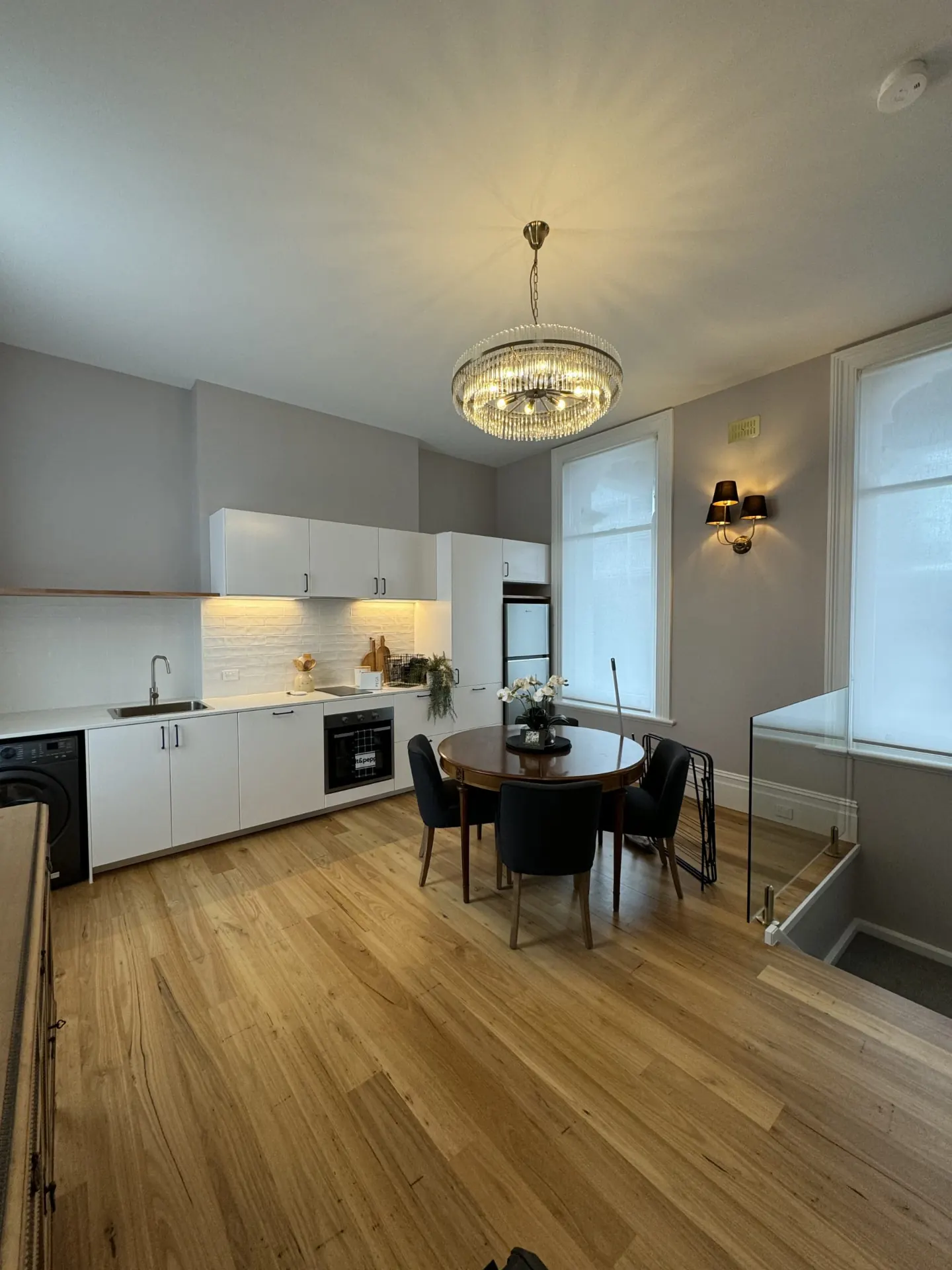
Kitchen and dining lighting
Replace one light, change to LED, or fix the wiring: your options side by side
What we find decides the fix. Most jobs come down to one of these three.
If the whole house flickers, or a tap or appliance gives you a tingle, the fault may be in the supply. Call Ausgrid on 13 13 88 first: it's their network. If the fault is on your side of the meter, we fix it.
What you can safely do now
Most flicker isn't an emergency, but some is. Here's how to tell, and what to do.
Safe to do now
- Note which lights flicker, when it started and what else was running at the time.
- Take a short video of the flicker on your phone.
- Turn off a light that is flickering badly and leave it off until it is checked.
- If a switch, dimmer or light is buzzing, warm or smells of burning, switch that circuit off at the switchboard, or use the main switch, if the board is dry and safe to reach.
- Keep kids and pets away from anything buzzing, hot or sparking.
Don't
- Don't change downlights, drivers, transformers or dimmers yourself. They're wired in, and in NSW that work must be done by a licensed electrician.
- Don't keep swapping globes if the new ones flicker too. The fault is in the driver, the dimmer or the wiring.
- Don't touch the switchboard if it is wet, scorched or smoking.
Call straight away if
- Every light in the house flickers or dims, or some go bright while others go dim.
- You get a tingle or shock from a tap, shower or appliance. Call Ausgrid on 13 13 88 and keep everyone away from it.
- A switch, dimmer or light is buzzing, hot, sparking or smells of burning, even after you turn it off.
- There is smoke or fire. Get everyone out and call 000. Never put water on an electrical fire.
Questions people ask
Are flickering lights dangerous?
Sometimes. One LED flickering on its own is usually a failing light or driver. Flicker with buzzing, heat or a burning smell points to a loose connection, which is a fire risk, and whole-house flicker can be a supply fault. For those, switch off at the switchboard if it's safe, and call.
Why do my LED downlights flicker when I dim them?
Usually the dimmer was made for halogen globes. LEDs draw so little power that it can't control them smoothly. The fix is a dimmer rated for your LEDs, and LEDs marked as dimmable. We check they're listed to work together before we fit them.
Why do my lights dim when the air con or oven turns on?
A small, brief dip when a big appliance starts can be normal. A big dip, or flicker every time, points to an overloaded circuit, a loose connection or a weak supply. We test it and tell you which. If the whole house is affected, Ausgrid may need to check the supply.
Can I change the downlight myself?
No. Downlights, drivers, transformers and dimmers are wired in, and in NSW only a licensed electrician can do that work. Changing an ordinary globe is fine with the light switched off. If a new globe flickers too, the fault is in the fitting, dimmer or wiring, and that's our job.
Should I change my halogen downlights to LED?
Usually, yes. Halogens run very hot and use several times the power of an LED. Old halogens close to ceiling insulation are a fire risk. We change them over, fit a dimmer that suits the new lights, and leave each one the clearance it needs.
Can you fix it the same day?
Often, yes. Call 0402 079 953 and tell Lachie which lights are flickering. A driver, dimmer or single light can often be sorted on the first visit. You get the price before work starts, and if you're not happy with the work, we come back and fix it free.

Get a free quote from Lachie
Four quick details and Lachie will be in touch. Your quote is back within 24 hours, with no hidden fees.
- Free quotes. Back to you within 24 hours, in plain English, with no hidden fees.
- Upfront pricing. You know the cost before any work starts.
- 100% satisfaction guarantee. Not happy with the work? Lachie comes back and makes it right, free.
- Quality guarantee. Every job done to the Australian wiring rules (AS/NZS 3000), with parts that meet Australian standards, and tested before we leave.
Rather talk it through? Call Lachie on 0402 079 953