
Often fixed the same day
Safety switch keeps tripping? We'll find the fault and fix it
A safety switch trips when electricity leaks where it shouldn't, usually through a faulty appliance, water or a damaged cable. Lachie tests each circuit, finds it and fixes it.
5.0 from 24 Google reviewsUpfront pricesLicensed & insured
Offers on this job
- $0Call-out feeOn booked jobs, Monday to Friday, 7am to 5pm.
- $200 offSwitchboard upgradeOld fuses or no safety switches? Save on a new switchboard.
- $60 offYour first jobNew customers save on their first booked job.
The $0 call-out is for booked jobs: a time we have set together, with the work going ahead. It applies Monday to Friday, 7am to 5pm. After-hours emergency call-outs have a minimum charge of $349 + GST, and Lachie confirms it on the phone before he drives out.
Why your safety switch keeps tripping
A safety switch watches every circuit behind it. The moment power leaks somewhere it shouldn't, it cuts the power in a fraction of a second. When it trips, it's usually doing its job. The job is finding where the leak is.
- The safety switch that tripped
- A faulty appliance
- Water in an outdoor light or power point
- A damaged cable
- Too much on one circuit
The safety switch that tripped
Its lever drops to the middle or off. If it flicks straight back off when you reset it, there's a fault on that circuit right now. Leave it off and call.
A faulty appliance
The most common cause. Kettles, toasters, fridges, heaters and washing machines leak power as they wear out. If it trips when one thing goes on, that thing is the suspect.
Water in an outdoor light or power point
If it only trips when it rains, water is getting into a fitting outside. Garden lights, outdoor power points and pool equipment are the usual ones.
A damaged cable
A screw or nail through a cable in the wall, or a rodent chewing one in the roof, makes it trip with nothing plugged in.
Too much on one circuit
If a circuit breaker (not the safety switch) trips, the circuit is overloaded. A heater, kettle and air fryer on one power board will do it.
What usually causes it: more detail on each cause
A safety switch that trips is usually doing its job. The question is what it's protecting you from.
A faulty appliance Most common
Elements in kettles, heaters, ovens and hot water systems wear and start leaking current to earth, and so do ageing fridge and washing machine motors. Plug-in appliances can be unplugged. Hardwired ones, like an oven, need an electrician to isolate and test them.
Water in an outdoor fitting
Open weatherproof covers, cracked garden lights, pool pumps and fittings under leaking gutters let water in. It trips in or after rain, then works once things dry out, so the fault seems to come and go.
Damaged wiring
A screw or nail through a cable during a renovation, rats or possums chewing cables in the roof, or old insulation breaking down. These faults hide in walls and ceilings, so we find them by testing, not by pulling walls apart.
Too much on one circuit
This trips the circuit breaker, not the safety switch. Heaters, kettles and air fryers draw a lot of power, and double adaptors or power boards on one outlet add up fast. The fix is moving appliances around, or a new circuit.
One safety switch covering too much Older boards
Some homes have one or two safety switches for the whole house. Tiny leaks from every appliance add up until it trips, and a fault anywhere blacks out half the house. A safety switch on each circuit (an RCBO) fixes both.
A worn-out safety switch Less common
Safety switches can fail, but it's rarely the cause. We test how quickly and at what level it trips before we replace anything.
When it trips tells us where to look
Note what was running and what the weather was doing when it went. It saves time on the day.
It trips the moment you reset it
The fault is there right now: a short circuit, a damaged cable, or a faulty appliance still plugged in on that circuit. Leave it off.
It trips when one thing turns on
If it goes every time the kettle, heater or washing machine starts, that appliance is the likely cause.
It trips when it rains
Water is getting into something: an outdoor power point, a garden or security light, or a fitting under a leaking gutter or roof.
It trips at random, often overnight
Something is switching itself on, like a fridge, a freezer or off-peak hot water. These are the hardest to catch, so we test rather than guess.
A circuit breaker trips, not the safety switch
That points to too much load on one circuit, like a heater and kettle on one double adaptor, or a short circuit.
It won't reset at all
If the lever won't stay on, the switch still senses the fault. Forcing it isn't safe.
How we fix it
We test before we replace anything, so you only pay to fix what's actually faulty.
- 1
Talk it through on the phone
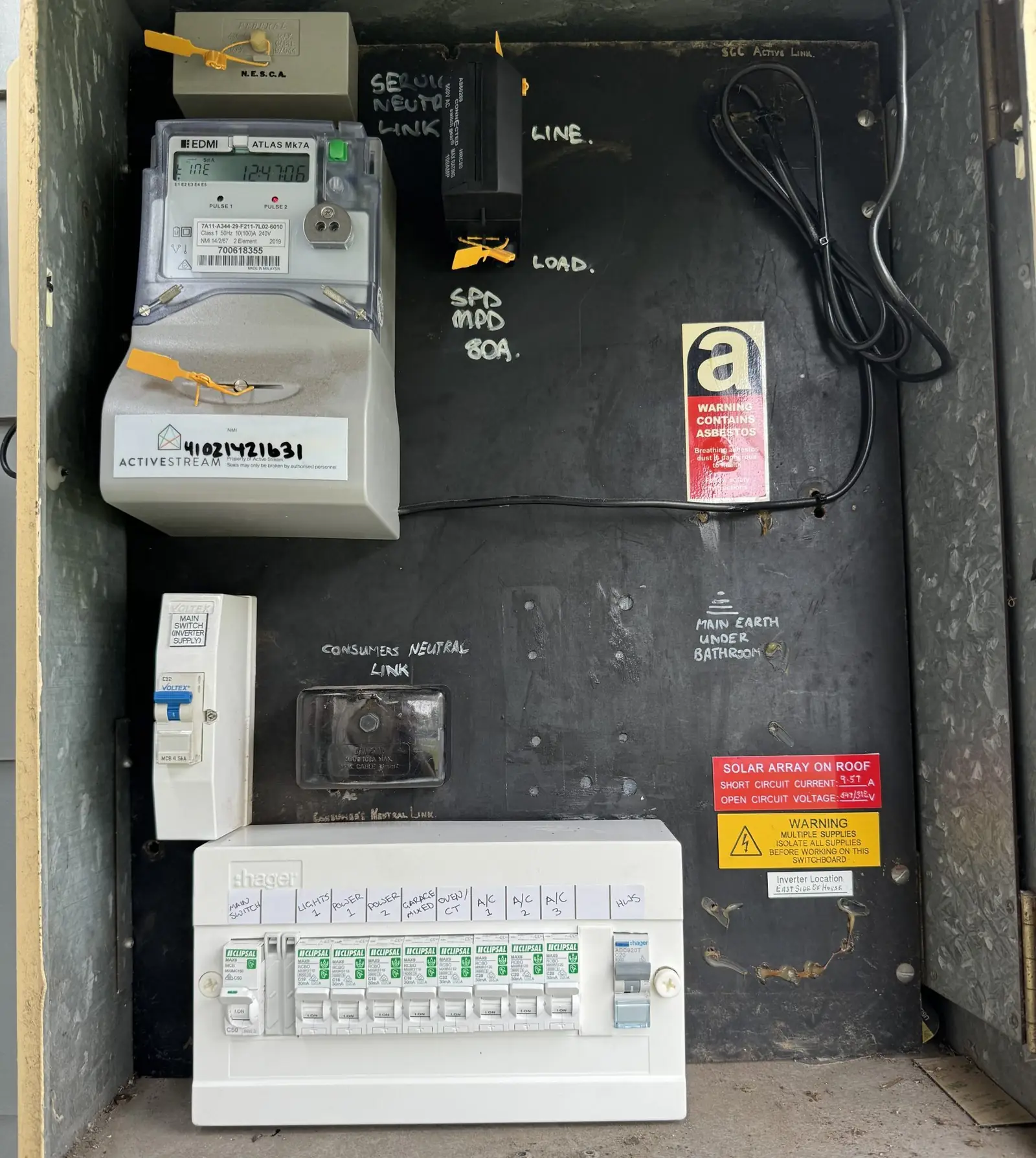
Lachie asks what tripped, when, and what was running. A photo of your switchboard helps. If anything sounds dangerous, he'll tell you what to switch off first.
- 2
Test each circuit
At the board, Lachie isolates each circuit and tests its wiring with an insulation resistance tester. It shows which circuit has the fault, even one that only trips now and then.
- 3
Find the faulty part
Then he narrows it down. Appliances on that circuit are tested one at a time, outdoor fittings are opened and checked, and a damaged cable is traced to where it's been hit.
- 4
Fix it, test it, show you
We repair or replace the faulty part, check the safety switch trips as it should, and show you what we found. If the board is part of the problem, we explain why and price it first. You get a Certificate of Compliance for Electrical Work (CCEW) where the work needs one.
Fix the fault, add safety switches, or upgrade the board: your options side by side
Most tripping is fixed by finding the faulty appliance, fitting or cable. The board only comes into it when it's part of the problem.
A safety switch that keeps tripping is protecting someone from a shock or a fire. Never have it removed, bridged out or swapped for a plain circuit breaker. Find the fault instead.
What you can safely do now
These are safe for anyone. Anything inside the switchboard, a power point or a fitting is a licensed electrician's job.
Safe to do now
- Unplug the appliances on the circuit that tripped, but only if they're dry and safe to touch.
- Reset the safety switch once. If it trips again, leave it off.
- Note what was running and whether it was raining, and take a photo of the switchboard.
- Keep the fridge and freezer closed if they're on the circuit that's off.
- Keep kids and pets away from anything wet, damaged or hot.
Don't
- Don't keep resetting it, hold the lever on, or tape it up. Each trip is the switch cutting power to a fault.
- Don't touch a switchboard that's wet, scorched, buzzing or smells hot.
- Don't open power points, outdoor fittings or the switchboard cover, or try a quick fix.
- Don't keep using an appliance you think is faulty, even on another circuit.
Call straight away if
- It trips straight back off and you can't keep the fridge, lights or medical equipment running.
- There's a burning smell, buzzing or scorch marks at the board, a power point or a fitting. Switch off the main switch if it's safe to reach. If there's smoke or fire, call 000 and never put water on it.
- You feel a shock or tingle from a tap, the shower or an appliance. Keep everyone away from it and call Ausgrid on 13 13 88 first.
- Water is dripping from a light, fan or ceiling. Keep clear and switch off the main switch if you can reach it without touching anything wet.
Questions people ask
Why does my safety switch keep tripping?
It's sensing current leaking to earth, which is what happens just before someone gets a shock. Usually it's a faulty appliance, water in an outdoor fitting or a damaged cable. Testing each circuit tells us which.
What's the difference between a safety switch and a circuit breaker?
A safety switch (RCD) protects people. It cuts the power in a fraction of a second if current leaks to earth, for example through a person. A circuit breaker protects the wiring from too much load or a short circuit. Safety switches usually have a test button marked T or Test.
Is it safe to keep resetting it?
No. Reset it once. If it trips again, the fault is still there and the switch is doing its job. Leave it off and call us. Resetting it over and over, or holding it on, keeps switching power back onto the fault.
Why does it trip at night when nothing is on?
Some things switch themselves on: fridges, freezers, off-peak hot water, pool pumps, and outdoor lights on timers or sensors. Dew and overnight rain also get into outdoor fittings. Testing shows which circuit it is.
Do I need a new switchboard?
Not usually. Most tripping is an appliance, a wet fitting or a damaged cable. If your board has ceramic fuses, one safety switch for everything, no room or heat damage, Lachie will tell you and price it. The choice is yours.
Can you come today?
Often, yes. Lachie works Monday to Friday, 7am to 5pm, and takes urgent calls from 4am to 9:30pm, 7 days. Many tripping faults are fixed the same day. Call 0402 079 953 for a time and a price.

Get a free quote from Lachie
Four quick details and Lachie will be in touch. Your quote is back within 24 hours, with no hidden fees.
- Free quotes. Back to you within 24 hours, in plain English, with no hidden fees.
- Upfront pricing. You know the cost before any work starts.
- 100% satisfaction guarantee. Not happy with the work? Lachie comes back and makes it right, free.
- Quality guarantee. Every job done to the Australian wiring rules (AS/NZS 3000), with parts that meet Australian standards, and tested before we leave.
Rather talk it through? Call Lachie on 0402 079 953