
Often fixed the same day
Dryer, washing machine or dishwasher tripping the power? We'll test the appliance and the circuit
Usually it's the appliance: a worn heating element, or water leaking onto a motor or pump. Sometimes it's the laundry power point or circuit. Lachie tests both.
5.0 from 24 Google reviewsUpfront pricesLicensed & insured
Offers on this job
- $0Call-out feeOn booked jobs, Monday to Friday, 7am to 5pm.
- $60 offYour first jobNew customers save on their first booked job.
The $0 call-out is for booked jobs: a time we have set together, with the work going ahead. It applies Monday to Friday, 7am to 5pm. After-hours emergency call-outs have a minimum charge of $349 + GST, and Lachie confirms it on the phone before he drives out.
What trips the power in the laundry
Usually it's one of the machines: a worn heating element, or water reaching a motor or pump. Sometimes it's the laundry power point or the circuit.
- Water near the power point
- The dryer's heating element
- The washer's motor and pump
- Two machines on one power point
- The safety switch
Water near the power point
Splashes from the tub, steam and lint get into laundry power points. Damp, worn contacts leak power or overheat.
The dryer's heating element
Elements crack and corrode with age, and a worn one leaks to earth as it heats. A breaker that trips partway through a cycle can mean the circuit is near its limit.
The washer's motor and pump
A split hose or worn seal can drip onto the motor, pump or wiring, so it trips one wash and not the next. Front-loader heating elements wear out too.
Two machines on one power point
A dryer draws close to what a power point is rated for. Run it and the washer from one double power point and the breaker can trip.
The safety switch
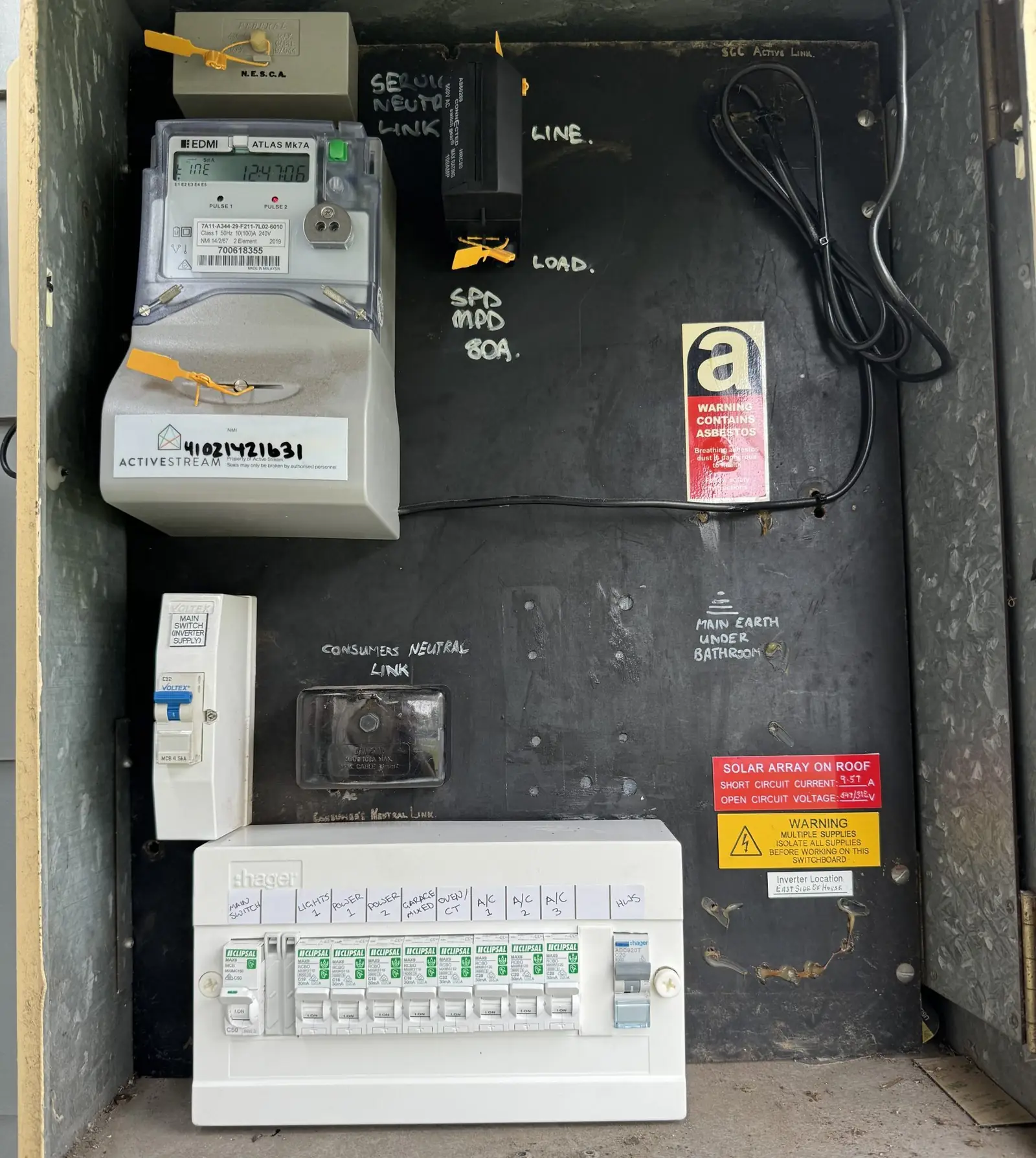
Unplug both machines, then reset it once. If it trips again with both unplugged, the fault is in the wiring. Leave it off and call.
What usually causes it: more detail on each cause
Most laundry and dishwasher trips are the appliance. The power point and circuit come next.
A worn heating element Most common
Dryers, front-loaders and dishwashers all have elements. Over time they crack or corrode, moisture gets in, and current leaks to earth. The safety switch trips as the element heats.
Water leaking inside the machine
A split hose, a worn pump seal or a failed door seal can drip water onto the motor, pump or wiring. It can trip one wash and be fine the next, depending on where the water runs.
Too much on one circuit Breaker trips
A dryer draws close to what a standard power point is rated for. Share its power point or circuit with the washing machine, an iron or a heater, and the breaker trips partway through.
A worn or damp laundry power point
Laundry power points sit behind machines that vibrate, in a room full of steam and lint, near a tub that splashes. They wear, loosen and get damp, then leak or overheat.
A motor or pump breaking down
Washing machine motors, drain pumps and dryer motors age. Worn windings can leak current or draw too much as they start.
Damaged wiring to the laundry or kitchen Less common
A cable hit during a renovation, or old wiring in the walls, can leak when the load comes on. An insulation test at the switchboard shows it up.
When it trips tells us what's failing
Each of these machines has a heater, a motor and water. What trips, and when, narrows it down.
The dryer trips the breaker after 10 or 20 minutes
The element and motor run together for a long time. A breaker that goes partway through points to a circuit near its limit, or a connection heating up.
The washing machine trips as soon as it starts
If the safety switch goes the moment you press start, or as it fills, water may have reached the motor, pump or wiring inside.
It trips when the water heats
Front-loaders and dishwashers heat their own water with an element. If it only trips partway through a hot wash, that element is the likely fault.
The dishwasher trips its RCBO
An RCBO is a safety switch and circuit breaker in one, for a single circuit. If only the dishwasher's circuit goes, the fault is on it, very often in the dishwasher.
It trips when the dryer and washer run together
Two heavy machines on one double power point, or one circuit, can overload it. The breaker trips, not the safety switch.
How we fix it
We test the appliance and the circuit separately, so you know which one needs fixing.
- 1
Talk it through on the phone
Lachie asks which machine, which switch tripped and at what point in the cycle. The make, model and age help, and so does a photo of your switchboard.
- 2
Test the appliance
He tests the machine through its plug for insulation and current leakage. A hardwired dishwasher is isolated at the switchboard and tested at its connection.
- 3
Test the power point and circuit
Then the laundry or kitchen power point, the circuit it is on, and what else shares it. That shows whether the circuit is sound and big enough for the machines on it.
- 4
Fix it, or tell you who will
You get the price before any work starts. A worn power point is replaced, connections are remade, and an overloaded circuit is split or given a new circuit. If the machine is the fault, we tell you plainly: that's for an appliance repairer, or the manufacturer under warranty. You get a Certificate of Compliance for Electrical Work (CCEW) where the work needs one.
Fix the power point, add a circuit, or call an appliance repairer: your options side by side
Testing tells us which of these you need. Most homes only need one.
If the machine is under the manufacturer's warranty, call them first, since warranty repairs usually go through their own service agent. We can still test your circuit, so you can show them the fault isn't your wiring.
What you can safely do now
These are safe for anyone. Inside the machine, the power point and the switchboard is for a licensed electrician or appliance repairer.
Safe to do now
- Turn the machine off and unplug it, if the plug and the floor around it are dry and safe to reach.
- For a hardwired dishwasher, switch off its circuit at the switchboard instead, if the board is dry and safe to reach.
- Reset the safety switch or breaker once. If it trips again with the machine unplugged, leave it off: the fault is elsewhere on that circuit.
- Turn off the taps to the washing machine or dishwasher if there's a leak.
- Note which program was running and how far in it tripped, and take a photo of the switchboard.
Don't
- Don't touch the machine, plug or power point if there's water on the floor.
- Don't take panels off the machine or open the power point.
- Don't keep restarting the cycle to see if it trips again.
- Don't run the dryer from an extension lead or power board.
Call straight away if
- There's a burning smell, smoke, or a scorched plug or power point. Switch off at the switchboard if it's safe. Smoke or fire: call 000, and never put water on it.
- You feel a tingle from the machine, a tap or the laundry tub. Keep everyone away and call Ausgrid on 13 13 88 first, then us.
- Water from a leak has reached a power point or the switchboard.
Questions people ask
Why does my dryer trip the breaker after 10 minutes?
Once the element and motor are both running, the circuit is under heavy load. If it trips partway through, the circuit may be near its limit or shared with another heavy appliance, or a connection is heating up. If it's the safety switch instead, the element may be leaking.
Why does my washing machine trip the power when turned on?
Usually water has reached the motor, pump or wiring inside, or there is a short in the machine. If it trips when the water starts heating, the element is the likely fault. We test the machine and the power point to find which.
Why does my dishwasher trip the RCBO?
An RCBO protects just that circuit, so the fault is on it, most often in the dishwasher: a worn element, a leaking pump or water under the machine. If the dishwasher tests fine, we test the power point and cable.
Is it the appliance or my wiring?
Most often the appliance. We test the machine through its plug, then the power point and circuit. If the machine fails and the circuit passes, you need an appliance repairer or a new machine. If the circuit fails, we fix it.
Can the dryer and washing machine share a power point?
They can, but running both at once on one double power point puts a lot through it, especially the dryer. If the breaker trips when they run together, or the plate feels warm, a second power point on its own circuit is the fix.
Can you come today?
Often, yes. Lachie works Monday to Friday, 7am to 5pm, and takes urgent calls from 4am to 9:30pm, 7 days. Leave the machine unplugged until he gets there. Call 0402 079 953 and you get the price before any work starts.

Get a free quote from Lachie
Four quick details and Lachie will be in touch. Your quote is back within 24 hours, with no hidden fees.
- Free quotes. Back to you within 24 hours, in plain English, with no hidden fees.
- Upfront pricing. You know the cost before any work starts.
- 100% satisfaction guarantee. Not happy with the work? Lachie comes back and makes it right, free.
- Quality guarantee. Every job done to the Australian wiring rules (AS/NZS 3000), with parts that meet Australian standards, and tested before we leave.
Rather talk it through? Call Lachie on 0402 079 953